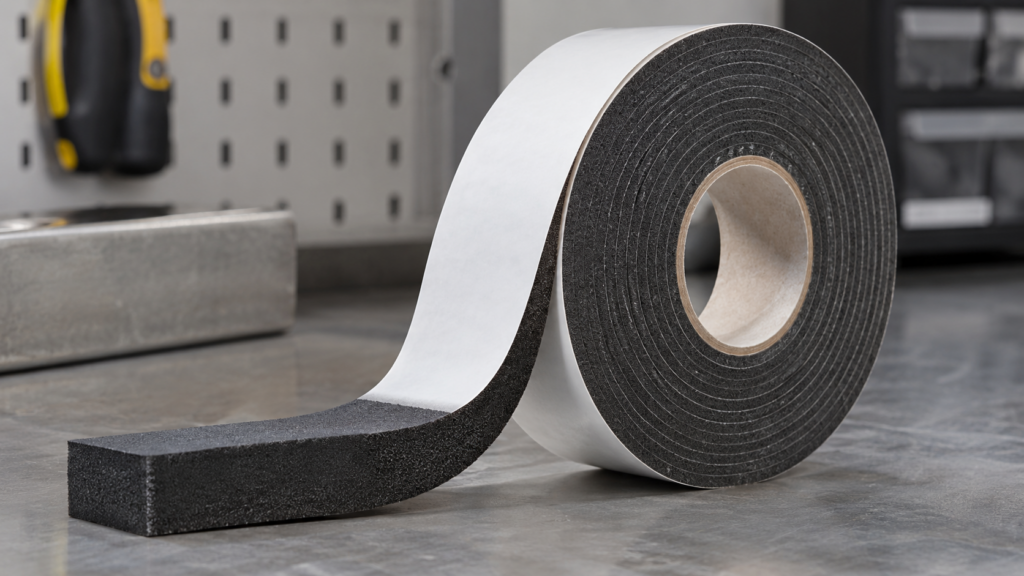
While standard foam tape performs well in many everyday applications, some environments require greater strength, higher compression resistance, and improved long-term durability. Heavy equipment, industrial enclosures, transportation systems, and demanding HVAC applications often expose seals to sustained loads, vibration, temperature changes, and repeated compression that exceed the capabilities of lower-density materials. In these situations, high-density foam tape provides the additional support needed to maintain seal integrity and consistent performance over time. Understanding when to upgrade from standard foam tape can help engineers improve product reliability while reducing maintenance and premature seal failure.
Understanding Foam Density
Foam density refers to the amount of material contained within a given volume of foam. While density is often associated with weight, it has a much greater impact on how the material performs under load.
Higher-density foams generally offer greater resistance to compression and deformation than lower-density alternatives. They are designed to maintain their shape and sealing force when exposed to sustained pressure, vibration, or repeated use. Lower-density foams, by comparison, compress more easily and are often selected for applications where soft cushioning or minimal closure force is the primary objective.
Density should not be confused with hardness. Two foam materials may feel similar during installation but perform very differently over years of service, depending on their formulation, cell structure, and resistance to permanent deformation.
When Standard Foam Tape Reaches Its Limits
Standard foam tape performs well in many sealing applications, but there are conditions where it may no longer provide adequate long-term performance. One common challenge is sustained compression. If a seal remains under constant load for extended periods, lower-density foam can gradually lose its ability to recover. As compression set develops, sealing pressure decreases, and gaps may begin to form between mating surfaces.
Applications exposed to heavy vibration present another challenge. Continuous movement places repeated stress on the foam, accelerating fatigue and reducing long-term sealing effectiveness. In these environments, a more durable foam structure is often required to maintain consistent performance.
Larger or inconsistent gaps may require a carefully selected combination of foam thickness, firmness, and conformability. While softer foams conform easily to irregular surfaces, they may not provide enough resistance to maintain reliable sealing pressure over time.
Recognizing these limitations early allows designers to select materials better suited to demanding operating conditions.
Benefits of High-Density Foam Tape
High-density foam tape is engineered for applications where durability is just as important as sealing performance. One of its primary advantages is improved compression resistance. Depending on its formulation, high-density foam may provide greater compression resistance and lower permanent deformation under sustained loading. Engineers should compare compression-set and compression-deflection data rather than relying on density alone.
Higher-density materials also provide better structural support. They help stabilize components while still accommodating minor dimensional variation between mating surfaces. In many applications, this combination of rigidity and controlled compressibility improves overall assembly performance.
Durability is another significant advantage. High-density foam tapes typically perform well in environments exposed to vibration, repeated movement, and mechanical stress. Their ability to retain physical properties over time helps reduce maintenance requirements and extend service life.
Balancing Compression Resistance and Surface Conformability
One misconception about high-density foam tape is that increased density automatically reduces sealing performance. In reality, effective sealing depends on balancing compression resistance with the ability to conform to mating surfaces.
Every assembly contains small variations in flatness, manufacturing tolerances, and surface finish. Foam must compress enough to fill these irregularities while maintaining sufficient force to keep the seal intact. High-density foam achieves this balance by resisting excessive compression without becoming completely rigid. It conforms to normal manufacturing variation while providing greater support than softer materials.
Selecting the correct thickness remains just as important as selecting the correct density. Even high-density foam should be designed to operate within its recommended compression range to maximize long-term performance.
Applications That Benefit from High-Density Foam Tape
High-density foam tape is commonly used in applications where sealing materials must withstand greater mechanical demands. Industrial equipment often relies on higher-density foam for access panels, machinery enclosures, and equipment housings that remain under continuous compression. These applications benefit from foam that maintains sealing force despite constant loading and vibration.
HVAC systems also present situations where high-density materials perform well. Air handling units, rooftop equipment, and commercial ventilation systems require durable seals capable of maintaining compression despite temperature changes and continuous operation.
Transportation applications, including commercial vehicles, rail equipment, and specialty vehicles, frequently use high-density foam tape to reduce vibration while maintaining environmental seals in demanding operating conditions.
Electrical enclosures are another common application. Foam gaskets used around doors and removable covers must maintain consistent sealing pressure to protect sensitive electronics from dust, moisture, and environmental exposure.
When Should You Upgrade to High-Density Foam?
Not every application requires higher-density materials, but several conditions often indicate that an upgrade should be considered. If existing seals develop permanent compression after relatively short service periods, higher-density foam may improve long-term performance. Similarly, repeated seal failures caused by vibration, heavy closure loads, or continuous compression often point toward the need for a more robust material.
Applications with large panel sizes or heavier doors can also benefit from increased compression resistance. The additional structural support helps maintain consistent contact pressure across the full sealing surface. Engineers should also evaluate operating temperatures, environmental exposure, and expected service life when selecting foam density. Applications designed for years of continuous operation frequently benefit from materials engineered for greater durability rather than minimum initial compression force.
Ultimately, standard foam tape provides excellent performance across a wide range of sealing applications, but some environments demand more. When assemblies experience sustained loads, continuous vibration, repeated compression, or greater mechanical stress, high-density foam tape offers the compression resistance and durability needed to maintain reliable sealing performance over the long term.
Partner with Gaska for High-Performance Foam Solutions
At Gaska Tape, we help engineers identify foam materials that match the mechanical and environmental demands of their applications. If you’re evaluating high-density foam tape for a new design or looking to improve the performance of an existing assembly, our team can help you select the right material, adhesive system, and converting solution. Contact Gaska Tape to discuss your application or request sample materials for evaluation.