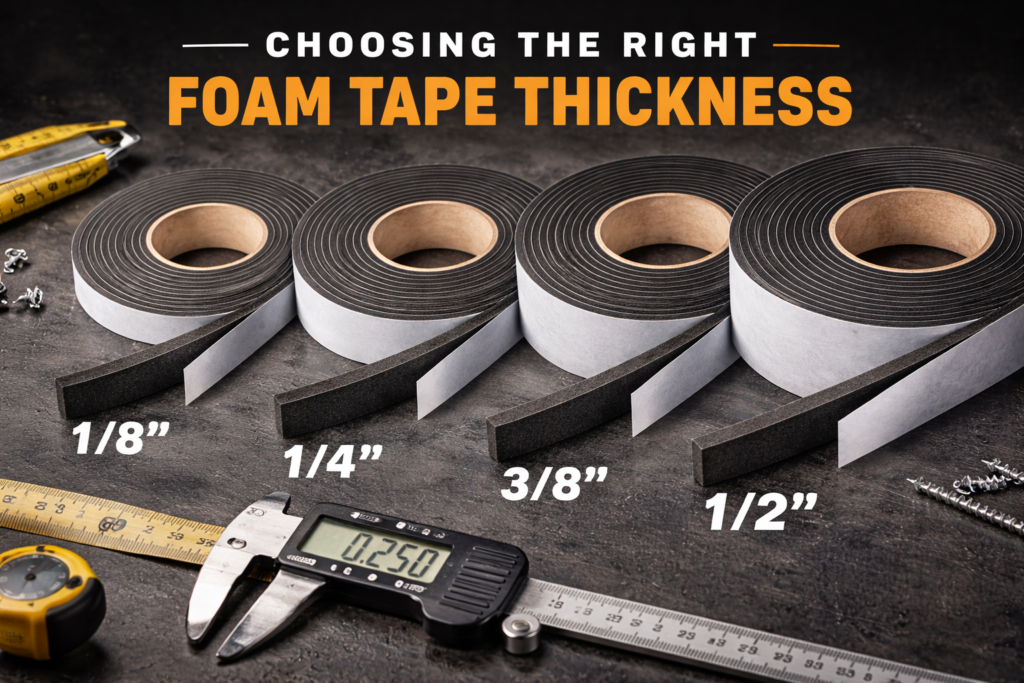
Choosing the right foam thickness may be the most important decision in seal design. Foam that is too thin will not fill gaps consistently, leading to leaks, rattles, or reduced protection against dust and moisture. Alternatively, foam that is too thick can require excessive compression force, potentially creating assembly challenges, uneven sealing, or long-term material fatigue and frustration. When foam thickness is chosen thoughtfully, it creates a reliable seal while maintaining a manageable compression force. This balance supports long-term performance across industries such as construction, automotive, HVAC, and industrial manufacturing.
Why Foam Thickness Matters in Sealing Applications
Foam thickness directly correlates with how a material seals against a surface, particularly irregular ones. In real-world assemblies, substrates are rarely perfectly flat. Small variations in surface finish, part alignment, or manufacturing tolerance can create gaps that a seal must accommodate and fill.
A foam seal works by compressing to fill those gaps and maintain consistent contact pressure. Thickness influences how much compression is available before the foam bottoms out, and it also affects how much force is needed to close the joint. A well-designed seal provides sufficient thickness to maintain continuous contact without requiring excessive force to compress it into place.
Seal Integrity vs Compression Force
Seal integrity requires consistent contact across the entire bond line. This contact is crucial for preventing unwanted airflow, moisture intrusion, vibration transfer, or thermal leakage. Compression force refers to the load required to compress the foam to its working thickness. These two factors, seal integrity and compression force, measure how well a seal does its job.
If the foam is too thin, the seal may not compress enough to compensate for gaps. This can result in intermittent contact, a common cause of sealing failure. If the foam is too thick, the assembly may require a higher force to close, and that force may exceed what fasteners, latches, or structural components can reliably deliver.
The goal is to select a thickness that provides an adequate compression range while staying within the assembly’s practical limits.
Understanding Compression Range and Working Deflection
Foam materials are typically designed to perform best within a certain compression range. While the ideal range varies by material type and density, many sealing foams are intended to operate at moderate compression rather than being fully crushed.
Working deflection is the amount by which the foam compresses in its installed state. A lightly compressed seal may not generate sufficient contact pressure, while an over-compressed seal may experience permanent deformation. Over time, that deformation can reduce sealing force and create leaks.
A properly selected thickness allows the foam to compress enough to form a secure seal while still retaining recovery and resilience over repeated cycles.
The Role of Foam Density in Thickness Selection
Thickness and density must be considered together. Two foams with the same thickness can behave very differently if their densities are different.
Lower-density foam typically compresses more easily, reducing closure force requirements. This can be useful for lightweight doors, access panels, or assemblies with limited fastening strength. Higher-density foam provides greater resistance to compression, which can improve sealing stability in applications exposed to vibration, wind load, or frequent movement.
If density is too low for the application, the foam may compress too easily and lose its ability to maintain contact pressure. If density is too high, the foam may require excessive force to compress, increasing stress on the assembly.
Environmental Conditions That Influence Thickness Requirements
Environmental exposure can change how foam performs, which impacts thickness selection. Temperature shifts cause materials to expand and contract. In cold environments, foam may stiffen and require more force to compress. In high heat, some materials soften and may compress more easily, potentially reducing adhesive longevity and contact pressure over time.
Moisture exposure can also be a factor. Closed-cell foams are often preferred in wet conditions because they resist water absorption and maintain dimensional stability. UV exposure, chemical contact, and long-term aging can affect foam resilience, which should be accounted for when determining thickness and compression targets.
Installation and Assembly Considerations
Thickness selection must match how the product will be assembled. A seal that performs well on paper can fail in production if it requires more closure force than the design allows.
Assemblies that use clips, light latches, or low-torque fasteners may need foam that compresses easily. Heavy-duty enclosures with rigid frames and strong fasteners may be able to accommodate thicker or higher-density foam for improved sealing stability.
It is also important to consider the compression uniformity across the joint. Uneven compression can occur when mating surfaces are misaligned or when fastening points are spaced too far apart. In those cases, thickness and density may need adjustment to ensure the seal performs consistently across the full perimeter.
A Practical Approach to Foam Thickness Selection
A reliable selection process starts with measuring the gap range in the assembly. This includes both the nominal gap and the worst-case variation caused by manufacturing tolerances.
From there, designers can choose a foam thickness that provides sufficient compression to accommodate the largest gaps while still allowing the assembly to close without excessive force. Evaluating compression force requirements alongside sealing performance helps avoid problems during installation and long-term use.
Prototyping and validation are essential, especially in applications exposed to vibration, moisture, or temperature cycling. Testing under real-world conditions provides confidence that the selected thickness will deliver consistent sealing performance over time.
Gaska’s Approach to Thickness Optimization
At Gaska Tape, we understand that foam thickness is not a one-size-fits-all decision. The right thickness depends on your gap profile, compression limits, environmental exposure, and performance expectations.
Our team works with customers to evaluate foam thickness, density, and adhesive options to support long-term seal integrity without creating unnecessary compression force. With in-house testing capabilities, rapid prototyping, and precision converting options, we help ensure the foam solution fits both the design intent and the production reality.
Foam thickness selection is a critical part of sealing success. By balancing seal integrity with compression force requirements, manufacturers can improve durability, reduce installation issues, and achieve more consistent performance. Contact Gaska Tape to discuss your application, review design requirements, or request sample materials for evaluation.