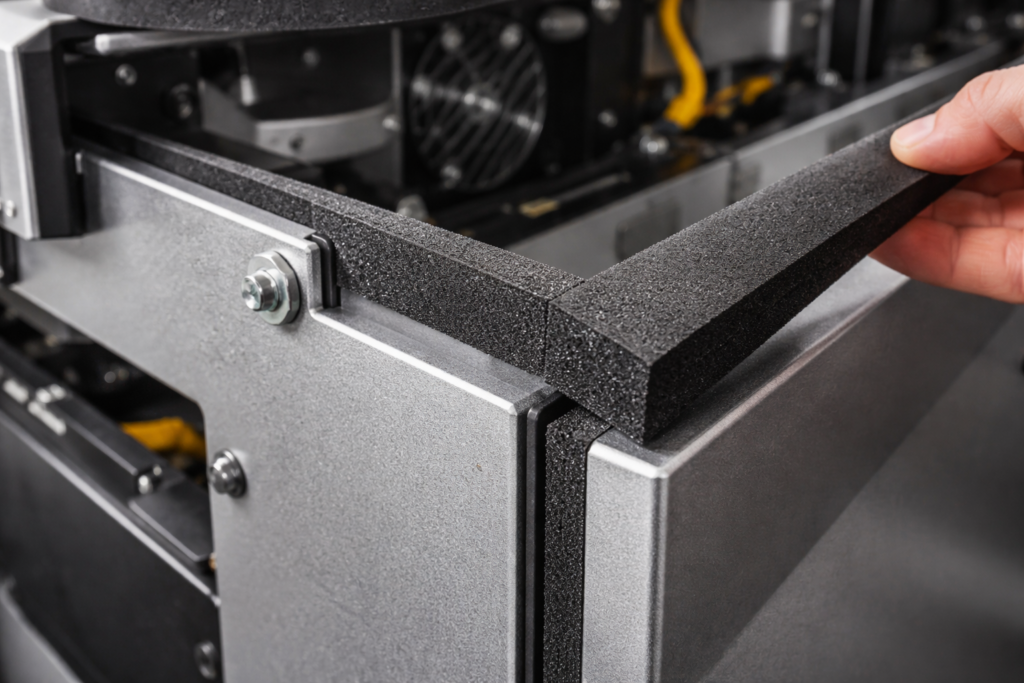
Most sealing applications are not static. Instead of being installed once and left untouched for years, some seals are opened and closed repeatedly during normal operation, inspection, or routine maintenance. These cyclic applications create different performance demands than one-time compression seals. A foam gasket may look and feel effective during initial installation, yet fail after repeated use because the material gradually loses recovery, the adhesive weakens, or the seal no longer maintains consistent contact pressure. For this reason, cyclic sealing should be treated as a distinct engineering challenge.
What Happens to Foam During Repeated Opening and Closing
Every time an enclosure is closed, a foam seal is compressed. When it is opened, the foam is expected to recover to its original thickness. Over hundreds or thousands of cycles, that repeated compression and recovery create material fatigue, often preventing the foam from returning to its original shape.
As the foam ages through repeated use, the sealing force can change. The gasket may initially experience strong compression and consistent contact, but over time, the foam can gradually lose elasticity. Small structural changes within the foam may also occur, including micro tears at the edges, cell collapse in high-pressure areas, or surface abrasion from repeated contact with mating parts.
Key Performance Properties for Cyclic Foam Seals
Key properties include the following.
Compression Set Resistance
Compression set is one of the most important properties for foam seals in repeated-use applications. It measures how well the foam returns to its original thickness after being compressed for a period of time. A foam with low compression set will recover more effectively and maintain sealing pressure across repeated cycles.
In cyclic sealing, compression set is influenced by foam composition, temperature, and dwell time. If a seal remains compressed for long periods between openings, recovery becomes more challenging, especially in warm environments where material softening can accelerate deformation. Designing for long-term recovery means choosing a foam that maintains resilience under real operating conditions, not just in ideal lab settings.
Resilience and Elastic Recovery
Resilience describes how quickly and consistently a foam returns after compression. In repeated opening and closing, resilience helps the gasket maintain a reliable contact pressure each time the enclosure is closed. If recovery is slow or incomplete, the seal may appear acceptable during assembly but may fail to provide consistent protection after extended use.
Tear Resistance and Durability
Repeated contact between a gasket and mating surfaces can create edge wear. Over time, this wear may cause tearing, abrasion, or localized damage that spreads across the seal line. Foam durability depends heavily on formulation, density, and the material’s overall structure. In many cyclic applications, the gasket edges are the first to fail because they experience the most wear. Designing for durability often means selecting foam that can resist abrasion and maintaining gasket geometry that protects vulnerable edges.
Foam Structure Considerations
Consider the following regarding foam structure.
Closed Cell vs Open Cell Foam
Closed-cell foam is typically preferred for repeated use sealing applications. Its structure provides better dimensional stability, greater moisture resistance, and improved long-term sealing performance in environments where exposure may vary over time.
Open-cell foam compresses more readily, but may be more susceptible to water absorption and contamination. For many access panel and enclosure applications, closed-cell foam offers more predictable long-term behavior.
Density Selection for Cyclic Applications
Foam density has a major impact on cycle life. Low-density foam can compress easily, which may reduce the required closure force. However, overly soft foam may collapse prematurely and lose sealing force after repeated compression.
Medium and high-density foams often provide better durability and recovery in cyclic applications, especially when vibration, frequent access, or long service life is expected. The best choice depends on the compression range, the closure mechanism, and the amount of force the assembly can consistently apply.
Adhesive Performance in Reusable Sealing Applications
In repeated opening-and-closing applications, adhesive performance is of the utmost importance. Each cycle introduces peel stress at the gasket’s edges.
Stress is also a factor, particularly when gaskets are installed vertically or when gravity and vibration apply a constant load over time. Adhesives used in cyclic applications must remain flexible and resist creep to prevent edge lift and shifting.
In some designs, mechanical retention may be recommended as an additional measure to adhesive bonding. This can include gasket channels, compression frames, or features that hold the foam in place even if the adhesive strength decreases over time. The goal is to prevent the gasket from moving while maintaining consistent compression performance.
Designing for Proper Compression Range
One of the most common causes of premature failure in cyclic foam seals is overcompression. When foam is compressed beyond its intended working range, the cell structure can collapse, and the material may not recover fully. This leads to permanent deformation and reduced sealing force.
A reliable design targets a controlled compression percentage that allows the foam to fill gaps and maintain contact pressure without being crushed. The seal must also maintain performance across tolerance stacking, ensuring it seals effectively even when mating parts vary slightly in gap size.
Mating surface design can also influence cycle life. Smooth, consistent surfaces reduce abrasion and help protect the foam. Sharp edges, rough finishes, or misalignment can accelerate wear and cause early tearing.
Environmental Factors That Accelerate Wear
Environmental exposure often increases the rate of gasket fatigue. Temperature cycling can cause foam to stiffen in cold conditions or soften in heat, changing compression behavior over time. Humidity and moisture exposure may affect both foam recovery and adhesive durability, especially in applications that experience condensation or outdoor weather.
UV exposure is another consideration for outdoor enclosures. Long-term exposure to sunlight can degrade certain foam materials and reduce sealing performance. Chemical contact also matters. Cleaning agents, oils, and industrial fluids may break down the foam structure or reduce adhesive strength if the material is not selected for chemical resistance.
Applications That Demand Repeated Use Foam Seals
Repeated opening and closing seals are common in electrical and electronics enclosures where access is required for inspection or servicing. Here are some common cyclical applications:
- HVAC service panels
- Industrial machinery
- Transportation compartments
- Consumer appliances
In each of these applications, gasket performance must be evaluated across the full expected service life, not only during initial installation.
How Custom Foam Designs Improve Cycle Life
Custom foam designs can significantly improve performance in cyclic applications. Die-cut gaskets ensure a consistent fit and placement, reducing variation that can lead to uneven compression. Rounded edges and optimized gasket profiles can reduce abrasion and minimize tearing during repeated contact.
Thickness and density can also be tailored to match closure force limitations while maintaining sealing pressure. Pre-applied adhesives can be selected based on the substrate material, operating temperature, and expected cycle stress.
Custom converting services enable the supply of foam gaskets in formats that improve installation consistency and long-term durability, especially in high-volume manufacturing environments.
Testing and Validation for Cyclic Performance
Cyclic sealing performance should be validated through testing. Cycle testing simulates repeated opening and closing to evaluate how foam recovery, compression set, and sealing force change over time. Compression and recovery testing can also provide insight into long-term behavior under realistic dwell times.
While lab testing is valuable, real-world testing often provides the clearest picture of performance. Factors such as vibration, handling, and environmental exposure are difficult to fully replicate in controlled settings. Testing foam seals in actual assemblies and real operating conditions helps ensure the selected material performs as expected.
Common Failure Modes and How to Prevent Them
Several failure modes are common in cyclic sealing applications. Permanent compression occurs when foam is over-compressed or lacks sufficient compression set resistance. Adhesive failure can develop from repeated peel stress, heat exposure, or contamination at the bond line. Edge tearing and abrasion often result from sharp mating surfaces, misalignment, or material selection that is too soft for the application. Loss of sealing pressure may occur gradually as foam recovers.
Preventing these issues requires selecting foam with the right compression properties, designing for controlled compression, protecting gasket edges, and validating performance through cycle testing.
Designing Foam Seals for Long-Term Reliability
Cyclic sealing applications require a different approach than static seals. A foam gasket that performs well during initial installation may not deliver the same sealing force after hundreds or thousands of cycles. Designing for long-term reliability means focusing on compression set resistance, elastic recovery, durability, and adhesive performance under repeated stress.
Foam seals remain a highly effective solution for repeated opening and closing applications when they are properly specified and supported by thoughtful design. With the right material and the right configuration, manufacturers can achieve consistent sealing performance throughout the product life cycle.
Partnering on Reusable Seal Design
Need a foam seal that holds up after hundreds or thousands of cycles? Gaska works with engineers to design foam sealing solutions optimized for repeated opening and closing applications. Contact our team to discuss your design requirements, evaluate material options, or request sample parts for cycle testing in your real-world environment.